|
|
| Line 30: |
Line 30: |
| Hence the sum of <math>\frac{1}{2}</math>,<math>\frac{1}{6}</math>,<math>\frac{1}{3} = 1</math> | | Hence the sum of <math>\frac{1}{2}</math>,<math>\frac{1}{6}</math>,<math>\frac{1}{3} = 1</math> |
| ==See Also== | | ==See Also== |
| [https://alpha.indicwiki.in/index.php?title=%E0%A4%AD%E0%A4%BF%E0%A4%A8%E0%A5%8D%E0%A4%A8%E0%A5%8B%E0%A4%82_%E0%A4%95%E0%A4%BE_%E0%A4%B8%E0%A4%BE%E0%A4%B0%E0%A5%8D%E0%A4%B5_%E0%A4%B9%E0%A4%B0_%E0%A4%AE%E0%A5%87%E0%A4%82_%E0%A4%B2%E0%A4%98%E0%A5%81%E0%A4%95%E0%A4%B0%E0%A4%A3 भिन्नों का सार्व हर में लघुकरण] | | [[भिन्नों का सार्व हर में लघुकरण]] |
| ==References== | | ==References== |
| <references /> | | <references /> |
| [[Category:Mathematics in Āryabhaṭīyam]] | | [[Category:Mathematics in Āryabhaṭīyam]] |
| [[Category:General]] | | [[Category:General]] |
Revision as of 16:19, 22 August 2023
Introduction
Here we will be knowing how to reduce fractions to a common denominator as mentioned in Āryabhaṭīyam.
Verse
छेदगुणं सच्छेदं परस्परं तत् सवर्णत्वम् ।
Translation
Multiply the numerator as also the denominator of each fraction by the denominator of the other fraction; then the (given) fractions are reduced to a common denominator.[1]
That is,


Example :
What is the sum of  ,
, ,
, ?
?
Multiply the numerator and denominator of each fraction with the denominator of other fractions.
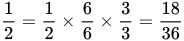


Now the denominators are same for the given fractions.
We have to add  ,
,  ,
,  to get the sum

Hence the sum of ,,
See Also
भिन्नों का सार्व हर में लघुकरण
References
- ↑ Shukla, Kripa Shankar (1976). Āryabhaṭīya of Āryabhaṭa. New Delhi. p. 70.

